Blog
A coffee with Massimo Rusci, welder at La Marzocco
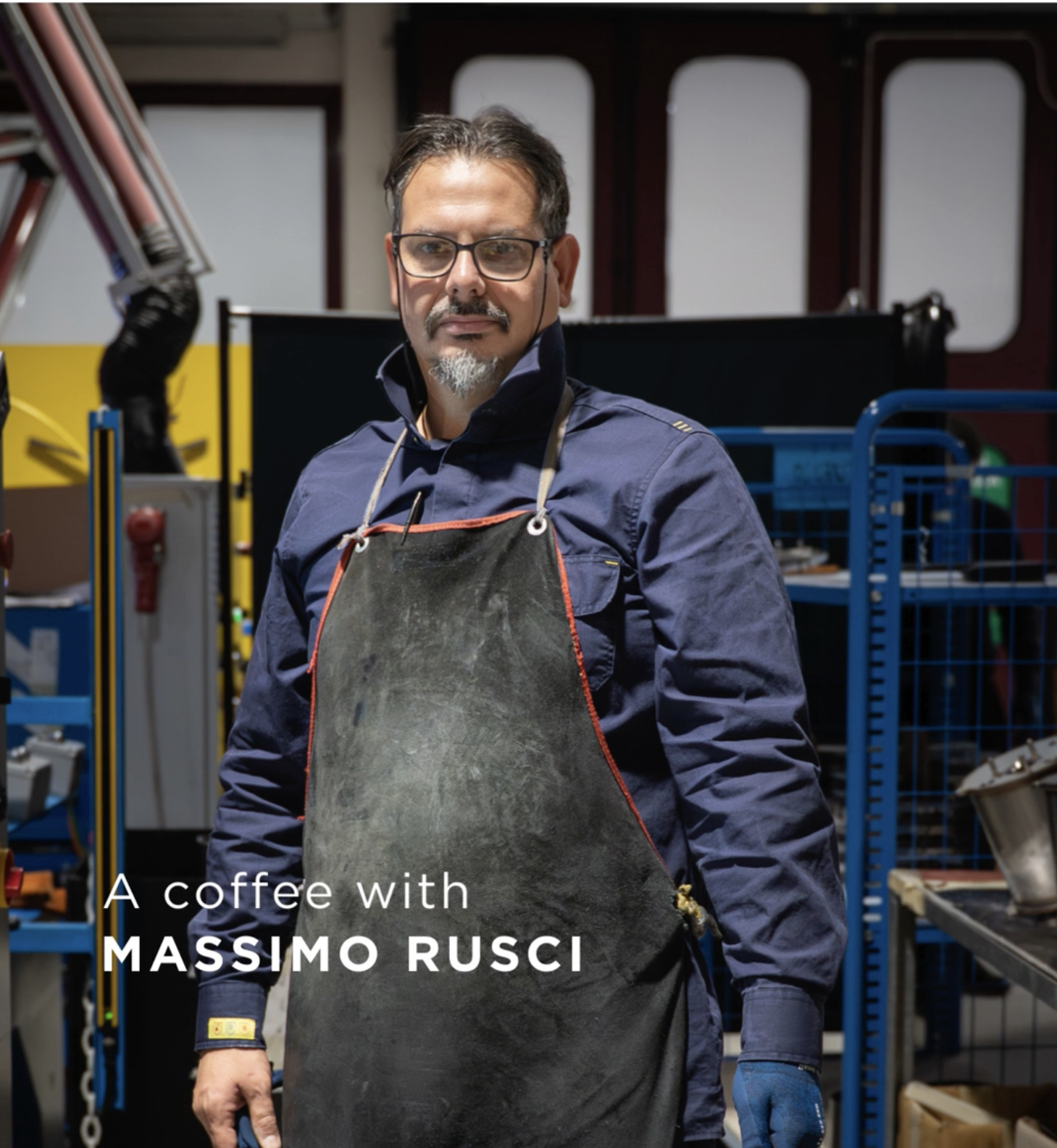
I was originally trained as a goldsmith. I studied at the State Institute of Art in Florence, where I graduated as a master goldsmith. At first, I worked as a model maker for costume jewelry, but I had to stop because of compulsory military service. Even though I did it in Florence, it was still an interruption, and after a year I started again with an internship at an artisan workshop in the city center.
For a year and a half, I worked in the studio of a master craftsman in Florence. After that, I spent about eighteen uninterrupted years working as a bench goldsmith. Essentially, that means soldering, piercing, grinding pieces of gold to create jewelry in general—sets, bracelets. It’s precision work, with very small measurements and thin thicknesses. A meticulous job, comparable to that of a watchmaker.
When the company I was working for began to face difficulties, chance led me to meet an acquaintance, Lorenzo Carcasci* who told me that where he worked they were looking for a welder. So I went in for an interview. Of course, I explained that I was used to welding things of a completely different nature, but I was told that wouldn’t be a problem—that I would be trained. So we gave it a try.
When I joined in July 2013, I initially worked in the packaging department to become familiar with the company and its products. In September, after the summer break, I began my welding training. Lorenzo Carcasci taught me—he was a historic welder who had started back in the days of Pian di San Bartolo, and at the time he was already part of the experimental department dedicated to prototypes.
Boiler production had been partly outsourced a few years earlier to increase output while maintaining quality standards, but there was an idea of bringing boiler production back in-house. The following year, I went to learn from an external specialist, and after that experience we began trying to restart internal production from scratch.
I started on my own, but I was soon joined by Leonardo (La Placa), and that’s when La Marzocco’s workshop and welding department dedicated solely to production was reborn. At first, it was just Leonardo and me, but gradually the need to increase production numbers grew.
For a while, another young worker joined us. Essentially, they handled preparation work while I trained them in welding. Slowly, more people joined, because welding and workshop work cannot exist without one another. You need a team in which welders can be supported by an almost equal number of people preparing the parts, since every piece must be washed and dried.
From the beginning, there has been significant evolution. At first, we simply managed as best we could. We were given free rein, with great trust. I was told, “Buy whatever you need.” Together with Lorenzo, we began improving each stage.
We built a first water-heating system for washing, and today we have an industrial washing system. But initially, pieces were washed by hand one by one, with sponges and heavy gloves, and then left to dry. Very artisanal processes that didn’t allow for large-scale production.
So, a series of improvements followed, combining productivity and safety. Because washing everything by hand takes an entire day. For a time, we even used a domestic dishwasher for the boiler bottoms. Today we have an industrial washing machine, an industrial parts washer, and an ultrasonic tank.
To complicate things further, there was also the factory expansion, with the workshop moving location three times.
Today we are two teams, fourteen people: six welders and eight preparers, two of whom are new and still in training.
The most difficult part of this job—which obviously requires training—is not the work itself but managing to get people to work well together. If you want results, people need to cooperate, especially if you want quality. That is truly the hardest part.
Because when a team grows, communication can become more difficult. The larger the group, the easier it is to find very different personalities, distant generations, different cultural backgrounds. What matters is finding common ground, and among us, it is working. The truly complicated part is getting along, because everyone is made in their own way.
In my determination, I have always managed to focus on the desire to learn a new craft, even when the person teaching me had a difficult personality. I’m speaking both of the masters I had in welding and in goldsmithing. I think it is a common trait among artisans in general: they often have brusque, gruff characters. But I believe this attitude is linked to the transmission of knowledge, which is not something obvious. In a way, it isn’t always pleasant to teach something that took years of experiments and trials to achieve.
It’s a complicated and delicate dynamic, if you think about it.
The creative artisanal side, the unexpected aspect of my work—which was sometimes even fun—I have partly lost today. But for me, the personal challenge remains: hitting the target. Making a commitment is important. A promise is a promise.
So despite unforeseen events, my goal today—pardon the wordplay—is always to hit the goal. That is my approach to work: a commitment to doing a good job, within the required time and manner.
Even though you cannot go below certain timeframes, otherwise you risk mistakes. People under stress lose focus, and making an error in welding is quite serious. Sometimes you can fix it, but it would be better not to.
When I look at a boiler, I can immediately tell if it was done well. The weld we make on a piece of steel is like inflicting a wound. One clean wound is fine. Fixing a mistake may work once, but after that the piece must be discarded.
That is why our group must work well and get along, because we are building boilers, not just any piece. Here we put the company’s reputation on the line.
It is an important factor, and also a point of pride. Last year we produced forty thousand five hundred and something boilers—I know, because I count them every week. And we started thirteen years ago with twenty pieces. My first delivery, I think it was March or May 2014, was twenty boilers. I was alone, so I had to cut them, drill them, wash them, weld them, and soak them in citric acid one by one, because I had a very small tank. Over the years, we have made quite a journey.
Today the department has become a cycle of things that must all move in the same direction. If something doesn’t work, everything becomes complicated. Even a flaw in what surrounds us delays us and creates problems.
Luckily, the teams are united. Spending so many hours together, you gradually blend into a group. Today we are two separate teams working in shifts, each with its own production. Otherwise, managing all phases would be too complicated.
I don’t know if it would have been the same doing this job somewhere else. Because when I arrived, Piero (Bambi) was still here, and he managed to pass on a special sense of belonging.
I’ll share just one anecdote about Piero. Coming here as a goldsmith, I lacked certain specific mechanical and workshop skills. I came from a similar environment, but not the same.
So one time, when Piero came down to welding, I explained that I was struggling with something. Piero said, “Alright, don’t worry.” He went back upstairs to the office, and after a while I saw him return with some printed pages. He had gone up, printed out a manual, and brought it straight to me. He said, “I don’t see very well anymore, and I can’t do this process myself, otherwise I would have shown you. But this guide explains how it’s done, so you can learn.”
A simple gesture, but one that taught everything. That’s why I am proud to wear the La Marzocco lion on my uniform, for everything this company has represented in the world of coffee.