Blog
A COFFEE WITH
Klaus Thomsen
co-founder of Coffee Collective
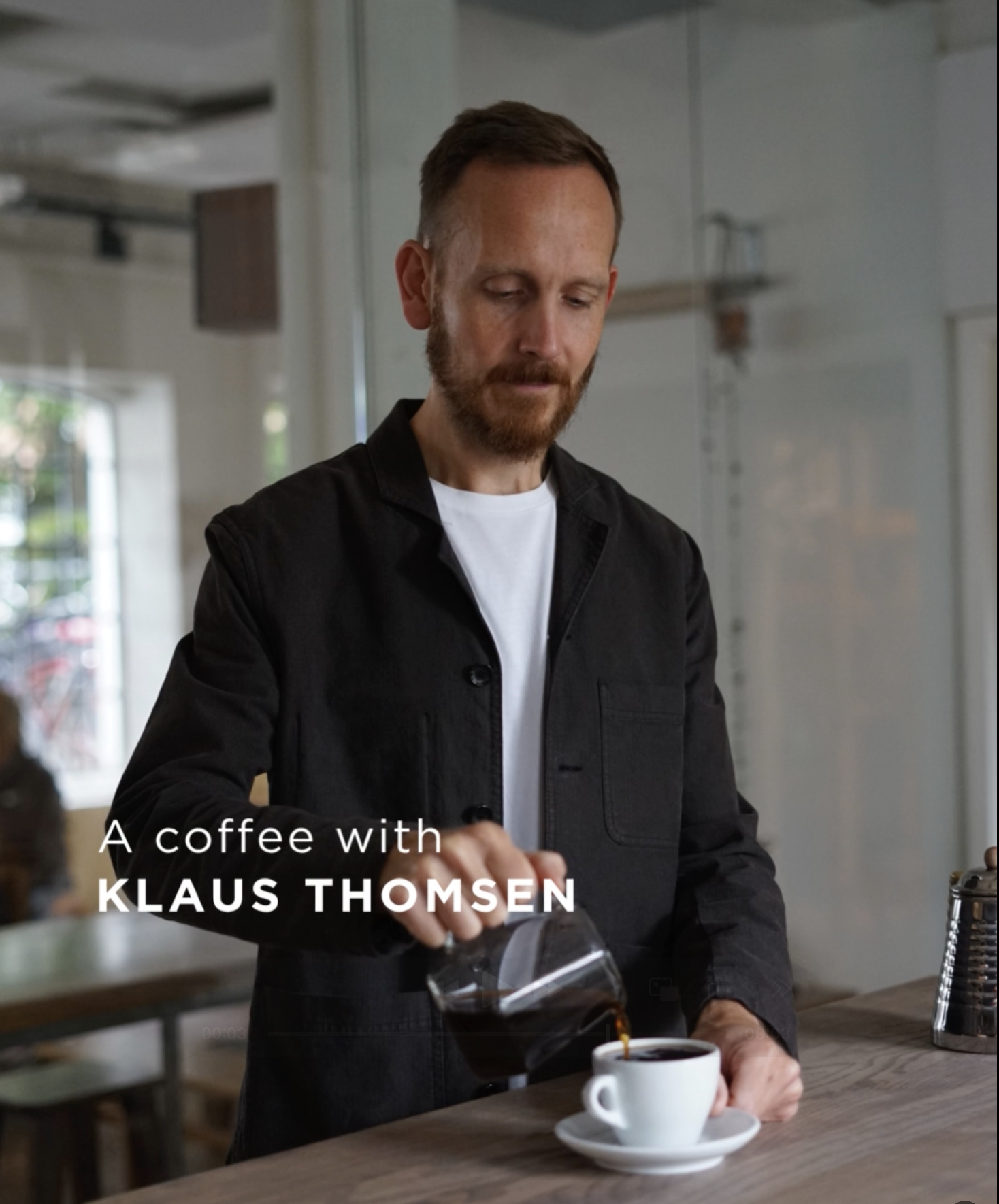
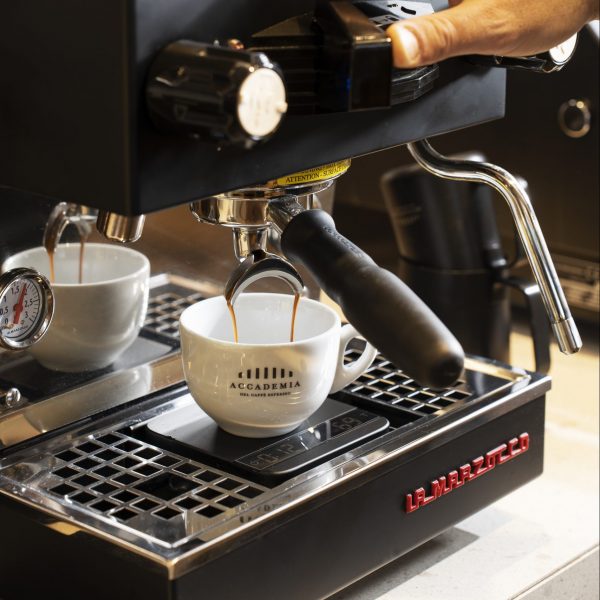
In 2001, I did my first barista training on a two-group Linea machine at the Starbucks training center, which I believe was in South London. I had never seen a portafilter before: there was something magical in the espresso flow and the crema forming in the two little glasses. Without that training, I don’t know if I would have ended up in the coffee world. Starbucks was transitioning to superautomatic machines—certainly easy to use, but a bit boring to me. That was my first phase in the world of coffee.
About a year later, back in Denmark, the second phase began. I wanted a home espresso machine—the luxury of making good coffee, steaming milk, having an espresso setup at home. Looking for online reviews, I stumbled upon a legendary forum, alt.Coffee, one of the first online coffee communities. There were people like Greg Scace, the inventor of the Scace Device (which we still use today to calibrate espresso machines). Within six months, I became a super enthusiast—reading books, talking only about coffee—and decided to find a job in a café while studying. I switched to one, then a better one, and eventually decided to enter the Barista Championship. To my surprise, I won the Danish title in 2004 and got to compete at the World Championship in Trieste, where I met people who are now dear friends, like Tim Wendelboe (who won that year), Sonja Grant from Iceland, and Stefanos Domatiotis from Greece. Today when we meet, it feels like a family reunion. That was another milestone: discovering an international coffee community full of great people brought together by the same passion.
After the Danish Championship, the company I worked for gave me the opportunity to travel, and I visited a huge estate in Brazil—Ipanema Coffees. It sat on the edge between specialty and commercial coffee, but seeing it in person—how coffee grows and is processed—was enlightening. I went back again before the World Championship to learn more. In 2005, I decided to take a year off to study and grow, and I visited another farm in Brazil: Daterra Coffees, where I discovered an even more advanced world, deeply focused on specialty coffee, and I learned so much.
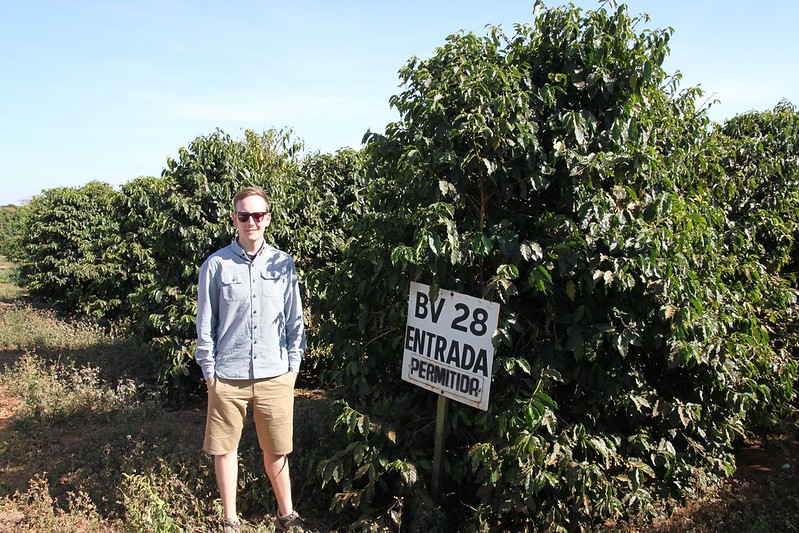
I decided to compete again in 2006, won the World Barista Championship, and went to Costa Rica to visit La Minita farm—quite famous and introduced to me by George Howell. As World Champion, you get a lot of invitations. I decided to accept every single one from producing countries, even without getting paid. I wanted to soak up experiences and meet people, without thinking about profit. I’m glad I did. I traveled to so many coffee-producing countries I can’t even remember them all… and then Seattle, Portland, Cape Town, Tokyo. I discovered the world through coffee—one of the best things that’s ever happened to me.
In 2007, Peter, Casper, and I founded The Coffee Collective. It wasn’t planned. But when we visited farms, we saw that even those growing extraordinary coffee often couldn’t afford to pay their workers, because they weren’t getting paid fairly. It was frustrating: I could be on stage in Portland or Tokyo talking about coffee, celebrating it, while on the other side of the world the farmers were struggling to survive. So we asked ourselves: what can we do? Our first rule was to buy directly, with no intermediaries, to build relationships with producers, pay them better, and work together to build their identity—a brand that made them the heroes of our story. With direct contracts, we could verify and document what we paid, making everything transparent. Each year we would visit every producer to maintain a continuous, real relationship. We, from the Global North, have purchasing power, but we must sit and speak as equals: pay more for higher quality, to create a virtuous circle—better pay enables better coffee for the customer, who pays more and thus enables the farmer to invest and improve further.
It wasn’t easy. I remember our first shipment from Guatemala: we wanted 40 bags, less than a quarter of a container. The producers asked, “What about the rest of the container?” We said: “Close it and send it as is.” But they didn’t even know how to calculate the costs—they were used to selling full containers. We told them: “Split it, we’ll pay more per bag, it’s not a problem.” It was tough, but we cared. Another rule was: help existing producers grow before adding new ones. For a long time, our menu had very few coffees, but we were proud of it—because we knew every farmer personally, visited them every year, and bought enough to support them economically. Sure, we changed origins less often than other roasters, but for us it was about values: we didn’t want to chase the “coffee of the month”—we wanted to build lasting, sustainable relationships, helping farmers improve year after year. I believe that earned us a lot of respect in the industry. Today we can buy entire containers from some origins, and only when we reach that scale do we add new ones. It might be a new farmer in the same country—like in Ethiopia, where we now buy much more—or a new country. In recent years we’ve added Bolivia, Mexico, and Peru. We have a strong international network and know who to contact when we want to find out who’s doing great work in a specific country.
Often in our sector, roasters feel they must teach something to farmers—talking about special fermentations or varieties to plant. We don’t like that approach. We believe we must listen, respectfully, to those who often have very deep knowledge. A beautiful example is Daterra, one of the very first producers we worked with. After 18 years, we’re still working with them. This year they introduced us to a new producer, Miriam, in another region of Brazil. They’d heard about her and her incredible work with permaculture—an agricultural system that gives more back to the soil than it takes. They wanted to know more about her and introduced us. We tasted her coffee during a cupping session and it was extraordinary. Daterra didn’t gain anything from this connection—if anything, we might have bought more from them if we hadn’t met Miriam. But they didn’t care—they truly want to help grow the whole sector. This proves we shouldn’t tell farmers what to do—we must find them, listen to them, and support them. That’s why I believe so strongly in direct trade: I wish more roasters would take the responsibility to go to origin to learn—not to market themselves or impose ideas. There are thousands of extraordinary producers we don’t know yet. Instead of all competing over the same “competition coffees” (I really hate that term), we could discover small gems, amazing producers who could improve quality even more, in a more sustainable way, if only they were paid better. Those who buy only from an importer’s list miss out on all this: the chance to meet incredible producers, to build a direct relationship, to watch them grow year after year. And that’s something I’m proudest of: seeing how much some of our long-time producers have improved since we started working together. It’s a win for them, for us, and ultimately for the person drinking the coffee.
That was our approach to sourcing. And then we wanted to open our own coffee shops—to control the full experience and ensure that people paying for quality actually get it. In Copenhagen, there were maybe two coffee shops doing quality. We wanted to create something different—raise the level of how coffee is prepared, presented, and experienced: combining service, the barista’s smile, a clean environment, the right music, the perfect lighting, and of course the taste and aroma of the coffee.
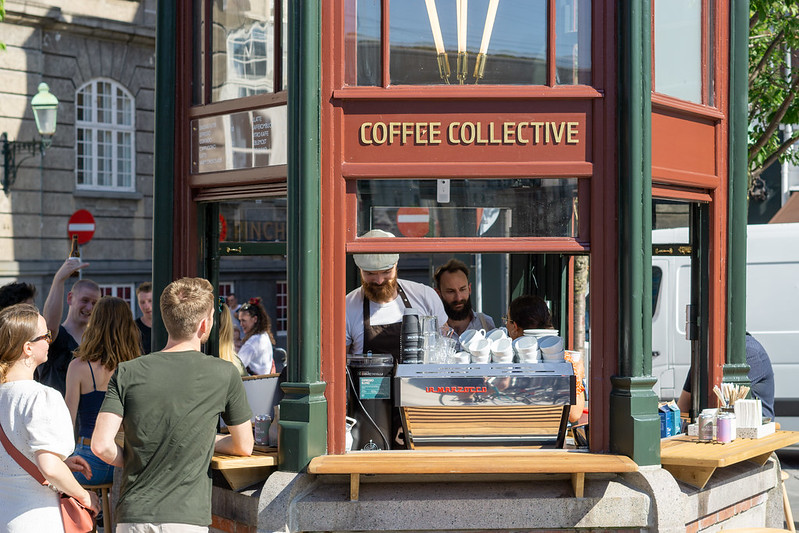
We started in a tiny space—probably the cheapest café ever: an IKEA kitchen built by a friend, the GS3 I won at the World Barista Championship (the first GS3 to leave the factory), and a GB5. We started interacting with customers, surprising them with latte art, and we could teach how to make great coffee. The Coffee Collective grew entirely through word of mouth—we never spent on advertising. Then we opened a second, a third shop, and now, after 17 years, we have 8 locations and about 160 employees. We want each café to be unique and to be present at every store opening. I still ride my bike every morning to visit most of our locations to stay connected. We brew extraordinary batch brew—liters of coffee prepared with obsessive care, precisely ground and measured. You can truly taste the earth and the farmer’s work. We also do pour-over with Kalita and AeroPress for different coffee expressions, along with all the classics—espresso and cappuccino. We always have two espresso options on the menu so customers can choose. We’ve done fun experiments too—like coffee kombucha, fermented like a natural wine, or a coffee soft-serve with fresh espresso: the sweetness of a cappuccino without bitterness. It’s great to let people taste coffee in new ways.
There’s been a huge change over 20 years. Denmark and Italy are a great example of how different coffee cultures can be. In Italy, people go out for a coffee, starting the day with a cappuccino and croissant. In Denmark, we eat breakfast and lunch at work and have dinner at home. But over the past 20 years, people have started going out to eat more. When I was a kid, there were no cafés—or maybe a few—in the capital. Coffee was consumed only at home, mostly brewed with a filter machine. If you had guests, you used a French press. When my mom stopped drinking coffee—I’m not sure why—my dad, since it was just for him, would pour boiling water over ground coffee using a cheap plastic cone and regular paper filters. He didn’t even have a grinder. But I remember that process so well: if I poured the water wrong, the coffee wouldn’t taste right. I learned it wasn’t automatic—and it was fascinating to be the final link in a long chain of people. You can make a difference in the final taste. Considering all the work and passion behind the coffee, making it well is both a responsibility and a pleasure. I think my love for coffee started right there—in the kitchen, pouring hot water over coffee, smelling it, and being aware that I was an active part of the process.
When I started working as a barista in Copenhagen around 2002/2003, many people told us it was just a passing trend, that we couldn’t open so many cafés. We replied that it wasn’t a trend—it was an evolution. And 20 years later, we were right. They said it was a niche, but today 98% of Danish households drink coffee. Not drinking coffee would be the real niche.
People who still drink bad coffee do so either because they don’t know better exists, or they can’t afford it. But that’s changing too: even the most expensive coffee today is still quite affordable. In this sense, it’s a very democratic product. Another big change is how coffee producers are treated: today their names appear on packaging, they are recognized. When we started, the producer was invisible, hidden in an anonymous blend. And then there’s the “geek” side—some people have super expensive espresso machines at home. But you can also have an amazing experience with a simple V60 or AeroPress and a manual grinder. Even a student can enjoy top-quality coffee at home. For me, this is a dream come true: today, coffee is celebrated, understood, appreciated.
The last piece still missing is economic: market prices are rising, and though it will be hard for many cafés, it’s the right thing. Farmers need to earn more. They must be able to look their children in the eye and say: “You can do this job. You can live from coffee.” That’s what we must achieve. One example: we were at the MAD Symposium (a major food event), and the last edition was seven years ago—before COVID. Back then it was hard to get people interested in coffee—they just wanted their espresso. But this year it was totally different: everyone was curious, asking what they were drinking, about the variety, the processing method, the farmer—not just the roaster, but the grower. It was an eye-opening moment: in just seven years, everything changed. Today in Denmark, I believe everyone knows at least one friend who’s a coffee geek. What used to be 1 in 1,000 now feels like 1 in 10.
Today, we certainly have many regulars who know exactly what they want. I love the variety of people who visit us. For example, downtown, we have many office workers who treat themselves to a great coffee each morning. For them, it’s a special moment before a day of average office coffee—a reward. They enjoy those five minutes of interaction, the barista’s smile… a lovely way to start the day. But they want speed—not a long conversation, just a quick “How’s your day?”, a fast filter or milk drink, and they’re off. That’s perfectly fine. At the same time, we have “coffee tourists”—people who visit Copenhagen for the food scene and already have a list of cafés to visit. They walk in with shining eyes like kids in a candy store and ask: “What should I try? An espresso? A filter? I don’t know!” And that’s our moment to guide them—which is the best and easiest part of the job because we just share our excitement. Right now, for example, we have a Takesi Geisha on the menu—maybe the best Geisha I’ve ever tasted in my life. So it’s easy to say: “You have to try it! It’s only here for 2–3 weeks. Don’t miss it.” This beautiful mix makes every day different.